
Succession in accountancy firms has entered a new and more complex phase. Evidence from the AGN–Nexia World Congress in Munich, supported by comparative survey data from 2019 to 2025, points to a profession at an inflection point. While firms report moderate preparedness for digital and AI adaptation, leadership readiness, talent pipeline strength, and ownership appeal are weakening.
Tune into our mini podcast on Spotify for a quick summary of the key insights.
For AGN member firms, this is not a future consideration. It is a present operating reality. The convergence of demographic shifts, changing leadership expectations, AI acceleration, and evolving client demands means that succession can no longer be managed episodically. It must be designed intentionally as a core strategic system.
The core finding is clear:
Leadership capability is shifting decisively away from technical mastery toward people leadership, advisory capability, and relationship stewardship. However, most firms lack the operating models, development infrastructure, and partnership structures required to build these capabilities at pace.
Succession is no longer a discrete ownership event. It is a continuous leadership system challenge that directly affects firm resilience, independence, and long-term value.
Partner Action Checklist
For AGN firms, the implications translate into five immediate leadership priorities:
- Formalise leadership bench strength assessment.
- Mandate structured client transfer protocols.
- Align partnership and financing models with next-gen expectations.
- Rebalance development toward people leadership and advisory capability.
- Establish a long-term succession pipeline linked to strategy.
This brief draws on longitudinal benchmark data and practitioner insight across the AGN association and underpins the AGN Resilience and Succession Advisory Readiness Assessment, delivered by Succession Strength in collaboration with AGN.
1. A Profession at an Inflection Point
Succession in mid-sized accountancy firms has reached a structural inflection point. Recent global partner discussions, reinforced by comparative survey data from 2019 to 2025, confirm that while firms are adapting technologically, leadership systems and succession infrastructure are not evolving at the same pace.
These conclusions were reinforced during partner discussions at the AGN–Nexia World Congress in Munich and validated against longitudinal benchmark data from Succession Strength’s 2025 Succession & Leadership Development Survey of accounting firm leaders, benchmarked against 2019 data.
Firms report moderate confidence in adapting to AI and digital change. However, this confidence masks a widening structural gap between technological and leadership readiness. While succession is receiving more attention, outcomes are not improving at the same pace.
Two indicators illustrate the challenge:
- Nearly two-thirds of firms give succession “high” or “top” priority
- Yet more than half still lack complete succession plans, and confidence in successor benches remains modest
This gap between intent and execution is becoming the defining risk. The implication for AGN firms is clear: technological adaptation without leadership adaptation creates fragility. The gap between declared priority and operational execution is now the defining succession risk.
“The scale of change facing the profession is structural rather than incremental.”
Rochelle Clarke – Succession Strength
2. The Three Critical Succession Challenges
Three-Risk Pillars Diagram
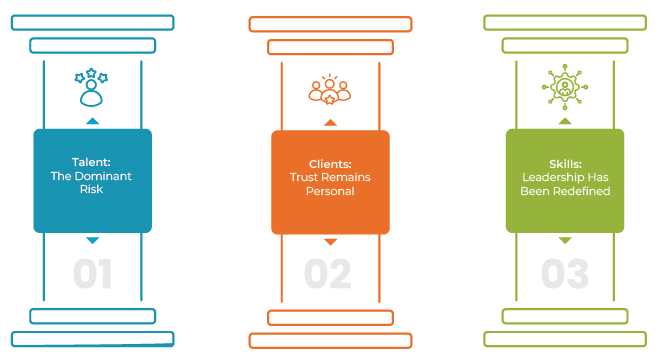
Talent: The Dominant Risk
For AGN firms, the talent challenge is not merely a recruitment issue, it is a system design issue. Firms that fail to institutionalise leadership development pathways risk compressing timelines, overpromoting underprepared leaders, or losing high potential talent to more progressive operating models.
Talent pipeline weakness is now the single greatest succession risk. Its prominence has nearly doubled since 2019, eclipsing structural, financial, and technical concerns. Faster promotion pathways are emerging, but without sufficient development depth, creating the dual risk of underprepared leaders or lost high potential talent.
Clients: Trust Remains Personal
The strategic risk is not that clients value personal relationships. It is that firms have not systematised those relationships. Institutionalising trust must become an explicit succession objective, not an informal expectation.
Client expectations have shifted rapidly toward speed, advisory value, and responsiveness. Yet trust remains heavily concentrated in individual partners rather than institutionalised within the firm. This exposes firms to disproportionate client risk during partner transitions and amplifies the consequences of poorly managed succession.
COMPARATIVE INSIGHTS: 2019 vs 2025
| What’s Improved | What’s Deteriorating |
|---|---|
| Complete succession plans: 22% to 39% Digital/AI training: 77% increased emphasis | Leader readiness: 3.8/6 to 3.6/6 Ownership appeal: 3.9/5 to 3.6/5 PE pressure: 28% to 50% reconsidering timelines |
Key Insight: The game is moving faster than firms can adapt.
“When benchmark responses were aggregated, talent pipeline weakness emerged as the single most significant succession risk.”
Rochelle Clarke – Succession Strength
Skills: Leadership Has Been Redefined
Leadership readiness must therefore be redefined within firm strategy. If partnership criteria, development pathways, and performance metrics continue to reward historic technical excellence alone, firms will unintentionally disqualify the leaders required for the next decade.
What it means to be “ready for leadership” has fundamentally changed. People leadership and advisory capability now outrank technical excellence as the defining leadership attributes. Digital and AI fluency have emerged as new baseline expectations, rather than differentiators.
3. Succession Is No Longer a Relay Race
The traditional model of succession assumes linear progression, predictable roles, and one-for-one replacement. This relay race view no longer reflects reality.
Today’s succession environment is dynamic and non-linear. Leadership is situational, roles evolve, and strategy adapts continuously. Effective succession now depends on building adaptive leadership capacity across teams, not simply identifying a next individual in line.
For AGN firms, this requires a shift from replacement planning to leadership capacity building. The objective is no longer identifying the next partner in line. It is constructing a resilient leadership system capable of adapting to changing strategic conditions.
“Succession used to be a relay race. Clear lanes, a baton handover, predictable outcomes. But that’s not the game we’re playing anymore. This is football now — roles change, situations change, and leaders have to adapt in real time.”
Rochelle Clarke – Succession Strength
4. Senior Leaders and Next-gen Perspectives
A consistent theme across practitioner input was the divergence between senior leaders and next-gen partners.
Senior leaders tend to prioritise advisory capability, resilience, and firm legacy. Next-gen leaders place greater emphasis on AI literacy, data capability, and sustainable work–life balance, with financing concerns remaining material for both groups.
This divergence is not a values conflict but a design challenge. Without explicit dialogue and redesigned development pathways, misalignment risks disengagement and attrition.
Misalignment is not a generational dispute. It is a structural communication and design gap. Firms that fail to reconcile these perspectives risk disengagement at precisely the moment when leadership continuity is most critical.
“Although senior leaders report that succession is a priority, next-gen partners consistently express lower confidence in readiness. The gap between declared attention and operational preparedness remains significant.”
Rochelle Clarke – Succession Strength
5. Six Critical Succession Themes
Together, these themes reveal that succession challenges are systemic rather than situational. Addressing them requires coordinated action across governance, development, financing, and culture, not isolated interventions.
Across benchmark data and practitioner input, several systemic patterns consistently emerge.
| 1. People leadership and advisory capability now define leadership readiness. |
| 2. Leadership pathways are accelerating without sufficient development infrastructure. |
| 3. Financing and ownership structures are increasingly misaligned with next-gen expectations. |
| 4. AI accelerates capability but does not replace leadership development. |
| 5. Client trust must be institutionalised rather than concentrated in individuals. |
| 6. Talent capable of leading through change remains the primary constraint on succession success. |
This brief draws on longitudinal benchmark data and practitioner insight across the AGN association and underpins the AGN Resilience and Succession Advisory Readiness Assessment, delivered by Succession Strength in collaboration with AGN.
“Technical excellence used to be the number one criterion for leadership. That’s no longer true. People leadership, advisory capability, and the ability to lead through change have overtaken technical skill — and many firms haven’t adjusted their development models accordingly.”
Rochelle Clarke – Succession Strength
6. From Symptoms to Root Causes: Smoke vs Fire
Many commonly cited succession problems are symptoms rather than root causes:
- Difficulty recruiting qualified candidates reflects failure to build long-term pipelines
- Perceived lack of ownership ambition reflects misaligned partnership models
- Client attachment to individuals reflects absent relationship transfer protocols
Addressing succession effectively requires moving beyond symptoms to redesign underlying systems.
For AGN firms, the practical implication is to move beyond tactical fixes. Recruitment initiatives, accelerated promotions, and reactive client transfer efforts will not resolve structural weaknesses. Leadership pipeline design must become a deliberate, long-term strategic priority.
“Most of the issues firms are dealing with are smoke, not fire. You say you can’t find qualified people — but that means you didn’t build a pipeline early enough. You say the next-gen doesn’t want it — but maybe the model doesn’t work for them.”
Rochelle Clarke – Succession Strength
7. What the Data Tells Us to Do Now
The data does not merely describe a problem. It establishes a timing imperative. Firms delaying structural decisions today narrow their strategic options tomorrow.
The Timing Reality
Leadership readiness typically requires seven to ten years from identification to partner-ready. Firms seeking ready successors today needed to start a decade ago. The next critical window is already forming.
The Investment Misalignment
There is a clear disconnect between what firms say is critical—people leadership, advisory capability, and digital fluency—and where development investment is actually directed, which remains heavily skewed toward technical training.
The Client Transfer Imperative
Formal client transfer protocols significantly outperform ad-hoc approaches in retention outcomes. Every partner within five years of retirement should already be operating within a formalised client transition framework. Where such protocols do not exist, immediate action is required.
“It takes five to ten years to prepare a leader properly. If you’re looking for someone ready today, you needed to start years ago. Succession planning done as a paper exercise, without aligning it to strategy, simply doesn’t work.”
Rochelle Clarke – Succession Strength
8. Two Futures: The Choice Ahead Firms
Firms face a clear choice
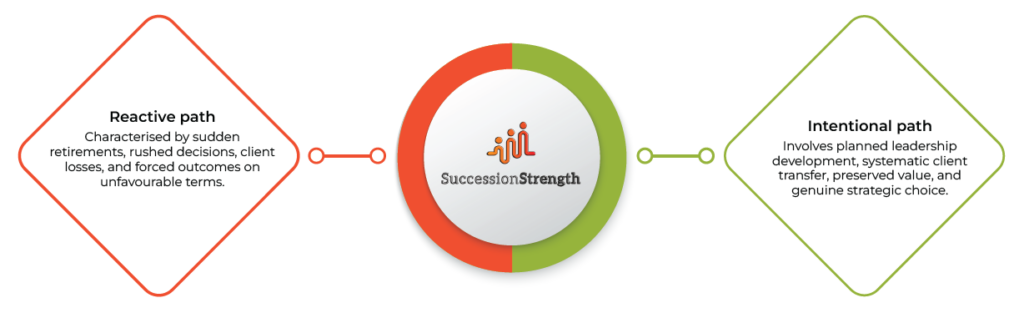
The difference is not awareness or intent, but timely decision-making.
For AGN firms, the decision is not whether succession will occur. It is whether it will be engineered intentionally or forced reactively. The difference will determine enterprise value, independence, and strategic choice over the next decade.
Firms either design succession intentionally or allow it to unfold reactively, often at the expense of value and strategic choice.
9. What AGN Firms Should Do Next
Succession risk is no longer theoretical. The data and partner discussion confirm that leadership continuity, client transfer, and operating-model alignment now require deliberate governance-level action.
AGN firms should prioritise the following over the next 12–24 months:
- Conduct a structured leadership bench strength assessment using objective criteria rather than informal opinion.
- Identify partners within five years of planned retirement and mandate formal client transfer protocols.
- Map next-gen leaders against future leadership requirements, including people leadership, advisory capability, and digital fluency.
- Rebalance development investment toward the capabilities required for tomorrow’s firm, not yesterday’s model.
- Review partnership and financing structures to ensure alignment with next-gen expectations.
- Establish clear mentoring and sponsorship accountability for senior partners.
- Document a 7–10 year succession pipeline plan explicitly linked to firm strategy.
These actions require clear ownership and board-level accountability. Informal succession conversations and paper-based plans are no longer sufficient to preserve independence and enterprise value.
As part of AGN’s commitment to supporting member firms through this inflection point, a structured Advisory Readiness Assessment and complementary advisory session are available to all members seeking to evaluate their preparedness and implementation pathway.
For further information, please contact Chris White at [email protected].
Further Reading – AGN Global Business Voice & Member Resources:
- The AGN Succession Journey Roadmap (Members only)
- GBV: Developing & Realizing Business Value (Public)
- The AGN Digital Maturity Diagnostic Tool (Members only)
- Generational Influence on Strategy Perspectives (Public)
- GBV: The AGN Advisory Migration Methodology (Public)
Member-only tools available at MyAGN (https://my.agn.org/)
For further information on this topic or anything relating to the AGN International Association of Accounting and Advisory Firms or to become an AGN member, please email your closest AGN Regional Director (see below) or go directly to www.agn.org.
Malcolm Ward
CEO AGN International
[email protected]
Robert Zhang
APAC Representative
[email protected]
Marlijn Lawson
EMEA Regional Director
[email protected]
Christian Moises
Americas Regional Director
[email protected]
Copyright © 2026 AGN International Ltd. All rights reserved. No part of this publication may be reproduced, distributed, or transmitted by non-members without prior permission of AGN International Ltd.


